Set in motion your journey
of getting closer to your self
Integrative Experiential Therapy for lasting healing and transformation.
● Online Therapy for Anxiety, Depression, Trauma, Relationship Challenges, Self-Esteem & Life Transitions
● New York, New Jersey, Massachusetts & Expats Abroad
• Culturally Attuned • Neuroscience-Backed • Evidence-Based • Impactful Therapy
• Culturally Attuned • Neuroscience-Backed • Evidence-Based • Impactful Therapy
You're working on yourself, but things still feels stuck. Looking for a therapist who could take you further than you can take yourself?Ready to move past surface-level talk and techniques you already know, toward real, lasting change?Looking for a therapist who adapts to you, uses a range of tools, and really gets the nuances of what you're going through?Answer “yes” To Any Of These Questions?
You’re in the right place
From Stuck to Deeper Change
Most therapeutic work manages symptoms. I focus on healing your subconscious patterns.
At In Praxis Therapy, I don’t just teach you how to cope. I help you rewire old patterns to put your desired change into practice and create the life of your dreams.
By working with me, you get:
Deep investment in your growth, paired with a sense of being truly seen
Attuned connection bringing in safety, play, nervous system tracking, and emotional release in every session
A deeper sense of fulfillment inside yourself and your relationships
A unique blend of clinically-backed modalities for transformative healing that lasts
If that's what you're looking for, let's connect!

I get where you’re coming from:
-
You've built your life around making things—the risk of it, the devotion it demands, and the love that keeps you returning. You know the creative blocks, the questions of identity and self-worth, and the distance between your inner world and the one you're asked to navigate every day. This is a space that makes room for all of it.
-
Navigating multiple cultures isn't always easy, and your heritage has shaped who you are in profound ways. As someone born and raised in New York City to Taiwanese immigrant parents, I understand the complexity of living between worlds, the sense of loss, the questions of identity, and the search for belonging that rarely has simple answers. Whether you immigrated yourself or inherited those experiences through your family, your story is seen, honored, and understood here.
-
You've worked hard to get where you are. From the outside, your life may look successful, but something still feels out of alignment, a quiet sense that the life you've built isn't quite the one you want to be living. Whether you're struggling with burnout, perfectionism, imposter syndrome, or the relentless pressure to keep achieving, therapy offers a space to look beyond productivity and explore what's driving it, what it's protecting, and what it's costing you.
-
You're living and working across countries, cultures, and time zones, constantly adapting to new places, communities, and ways of life. While that can be deeply enriching, it can also be isolating, disorienting, and difficult to put into words. Finding a therapist who understands the realities of a globally mobile life isn't always easy. Having worked and lived internationally, I understand many of the unique challenges that come with living between worlds. Together, we'll create a space that meets you where you are, wherever you are.
-
Challenging the status quo in pursuit of radical, necessary change can feel both energizing and deeply depleting. When the work is urgent and the stakes are high, burnout often follows from carrying too much for too long. Therapy can be a space to replenish, stay connected to purpose, and sustain the struggle.
-
How we learn to love, to need, and to pull away is often shaped early, long before we have any real choice in the matter. Those patterns don’t stay in the past; they follow us into our relationships, our bodies, and our deepest fears around closeness and abandonment. This work goes beneath the surface of those patterns, not just to manage them, but to understand and heal them, so that more secure, fulfilling connections can become possible.
-
Your depth of feeling is real, and it can make you feel different and out of place in a world that wasn't quite built for your nervous system. Therapy for highly sensitive people and empaths honors both the challenges and the gifts of experiencing life as fully as you do, and helps you find your footing without dimming what makes you who you are.
-
You may not always have the words for what happened, or it may have been so woven into the fabric of your early life that it just felt normal. Whether you're carrying a single event that changed everything, the accumulated weight of complex trauma, or the imprints of childhood wounds, the effects live in the present: in your body, your relationships, your sense of self. But what the nervous system learned to carry, it can also learn to release. Healing isn't just understanding what happened, it's feeling lighter, reconnecting with who you truly are, and no longer living through the lens of trauma.
-
Whether you're out, still finding your way, or somewhere in between, navigating queer identity, gender identity, sexuality, or questions that don't yet have names takes its own particular kind of courage. This is an affirming, LGBTQ+ informed space committed to approaching your identity with curiosity rather than assumption, where your full self is welcome, including the parts still unfolding.
-
You've never felt entirely at home, in your family, your culture, your professional world, maybe all of it. The one who sees things differently, who never quite fit the mold, who has always lived a little outside the frame. The one who sees things differently, who never fit the mold, who has always lived a little outside the frame. This is a space that won't ask you to fit into one, a space that understands that existing on the margins carries its own weight, and its own wisdom.
You don't have to figure this out alone
This is a space to slow down, go deeper, and find your way back to yourself.

Self-Worth & Inner Critic
There are parts that question you, hold you back, tell you you're not quite enough. This work goes somewhere deeper than positive thinking, to where that voice came from, and how to loosen its hold.

Life Transitions & Change
Something has shifted, or is shifting, and the ground doesn't feel solid yet. Whether you chose this change or it chose you, major life transitions have a way of surfacing a lot that was quietly waiting underneath. Therapy can help you find your footing again.

Anxiety & Chronic Worry
Your mind is working overtime, rehearsing, anticipating, bracing for what might go wrong. Anxiety treatment isn't about silencing your thoughts. It's about no longer being ruled by them, so you can actually be present in your own life.

Relationships, Dating & Attachment
The way we love, need, pursue, and pull away doesn't come from nowhere. It gets shaped in our earliest relationships, influencing how we fight and go quiet, how close we let people get. Relationship therapy and attachment work goes to the root of those patterns, not just to manage them, but to actually change them from the inside out.

Depression & Low Mood
There's a heaviness that's hard to explain to people who haven't felt it. Not just sadness, more like a distance from yourself, from others, from anything that used to feel like it mattered. Depression therapy goes beyond symptom management into what's underneath.

Questions of who you are, your values, your sense of belonging, your place in the world, can surface at any point in a life. Identity-focused therapy is for anyone in the process of figuring out what's actually theirs, what fits, and what they're ready to let go of.
Identity & Self-Discovery

The pressure to perform, to succeed, to hold it all together, and underneath it, the quiet fear that you're still not quite enough. Therapy helps you shift your relationship with your own worth, so your life isn't entirely organized around proving it.
Burnout & Work Stress

Trauma & PTSD
What happened then is still happening now, in your body, your reactions, your relationships. Trauma therapy isn't about revisiting the past for its own sake. It's about no longer being ruled by it, so the present finally has room.
Hi! My name is Grace! I hold a LMSW (Columbia) and EdM (Harvard) and I’m a psychotherapist licensed in New York (LCSW), New Jersey (LCSW), Massachusetts (LICSW), and Illinois (LMSW).
I am passionate about empowering people from diverse backgrounds to heal from past traumas, explore and express their authentic selves, and live more connected and fulfilling lives.
My clinical training spans the brain, the body, and the emotional and relational world, approaches that go beyond talking about what happened to actually reaching the parts of us that were shaped by it. Trauma lives below conscious knowing, and real healing has to meet it in the nervous system, in the body, in the felt sense of things shifting.
I work integratively, which means I follow what's actually alive in the room, guided by an overall picture of where we're going, rather than applying a fixed method to every person. I'm especially drawn to work that goes underneath, to what was absorbed early, to questions of identity and belonging, to the stories we've been living inside.
I come from an immigrant family and have spent much of my life moving between cultures, languages, and institutions, on the inside and the outside of many of them. The work of figuring out where you belong, what parts of yourself survive the crossing, what home even means, I know that work personally. It lives in how I listen, in what I notice, in my attunement to the things that don't translate and the identities that don't fit neatly into any frame.
Curiosity and genuine respect for difference are at the core of how I work. So is the belief that no two people, or two processes, are the same.

About Grace (Me!)
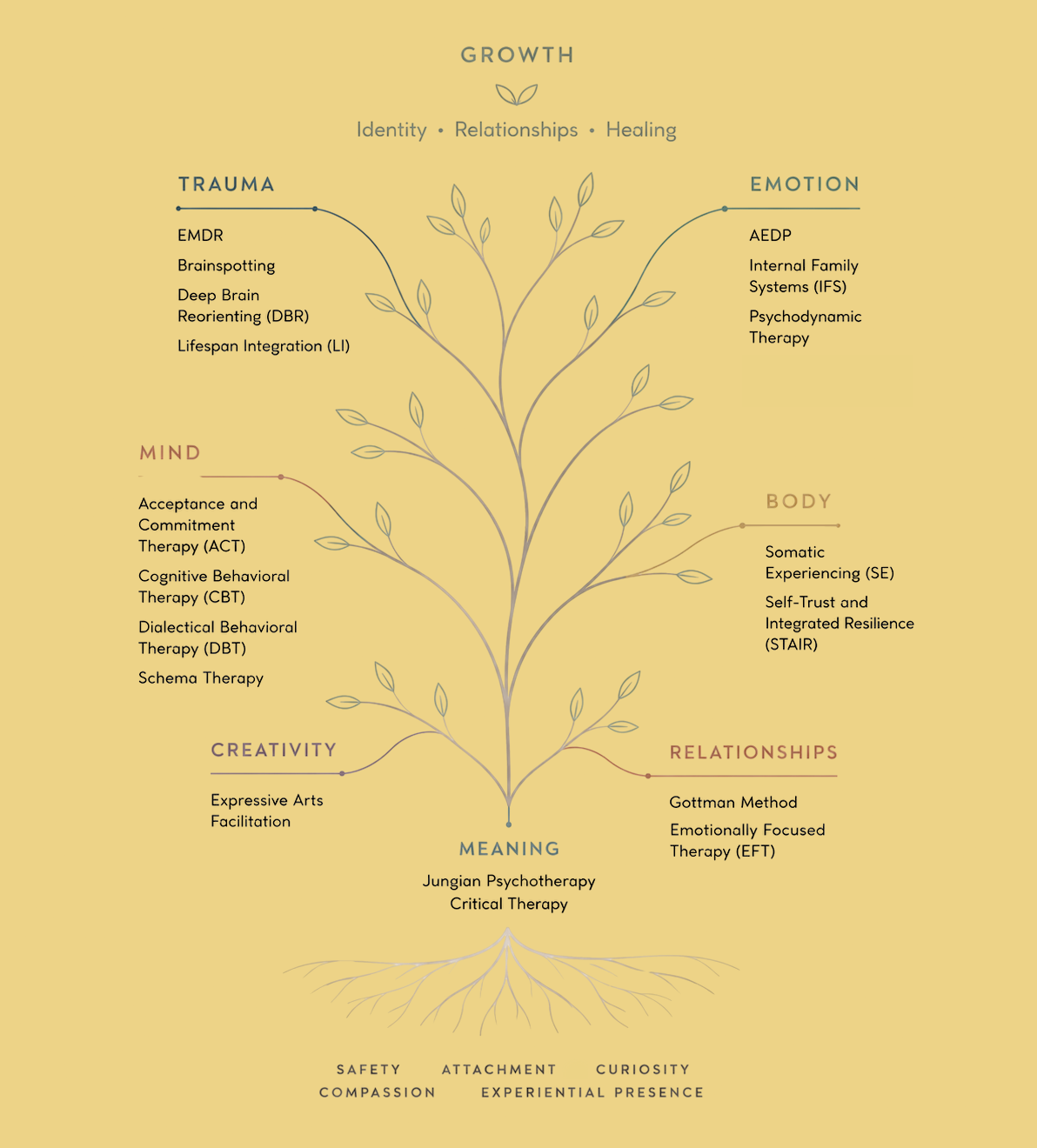
Approaches I Use
-
We all contain multitudes, the part that's driven, the part that's afraid, the part that shuts down, the part that's been carrying something for a very long time. IFS helps you develop a relationship with those inner parts, so they stop running the show unconsciously and you can lead your life from a more grounded, compassionate place.
-
Less about eliminating difficult thoughts and feelings, more about loosening their grip, so you can move toward what actually matters to you even when things are hard. ACT builds psychological flexibility, the ability to be present with discomfort without being controlled by it.
-
The past lives in the present — in patterns, in relationships, in the ways we respond before we've even had a chance to think. Psychodynamic work brings those patterns into view, tracing them to their roots so they lose their automatic power.
-
AEDP works with emotion and the therapeutic relationship as a vehicle for transformation, creating conditions where genuine change can be felt, not just understood. It's warm, present, and oriented toward what's possible and emergent.
-
A practical, evidence-based approach that looks at the relationship between thoughts, feelings, and behavior. Useful for identifying the patterns of thinking that keep us stuck, and developing concrete ways to respond differently.
-
Originally developed for intense emotional experiences, DBT offers real skills, for managing overwhelming feelings, navigating relationships, tolerating distress without making things worse. It's structured, practical, and genuinely useful for people whose inner lives can feel hard to regulate.
-
STAIR works to rebuild what difficult experiences can quietly erode, your trust in yourself, your capacity to feel steady, your ability to move through the world without being pulled back into the past. It draws on a range of experiential techniques, chosen carefully for what actually works, to help you find that groundedness from the inside out.
-
We develop deep beliefs about ourselves and the world early in life, often before we have the tools to question them. Schema therapy identifies those core patterns and the ways they shape everything, and works to heal them at the level where they were formed.
-
A well-researched trauma therapy that works with how the brain stores difficult experiences. Through guided bilateral stimulation, EMDR helps the nervous system process what got stuck, so memories lose their charge and the past stops intruding on the present.
-
Where you look affects how you feel. Brainspotting uses eye position to access and process trauma, emotional pain, and activation held deep in the brain and body, often reaching places that talk therapy alone can't get to.
-
Sometimes words aren't the right tool. Drawing, movement, image-making, and other creative modalities open different pathways into inner experience.
-
A newer approach that works at a neurological level, gently accessing the deep brain structures where shock and trauma are held before they even become emotion. Particularly effective for early or preverbal experiences that other approaches can't quite reach.
-
Sometimes we know the past is over, but our body hasn't gotten the message. Lifespan Integration uses a timeline of your life to help the nervous system experience, not just understand, that what happened then is not happening now.
-
Trauma lives in the body. SE works with the nervous system directly, tracking physical sensation, movement, and activation to help complete the survival responses that got interrupted, and restore a felt sense of safety from the inside.
-
A research-based approach to couples work that goes beyond conflict management, building real friendship, trust, and the ability to repair when things go wrong. Useful for couples at any stage, from early tension to long-standing disconnection.
-
Attachment shapes how we love and how we fight. EFT helps couples and individuals understand the emotional cycles driving disconnection, and find their way back to secure, genuine closeness.
-
Therapy doesn't happen outside of the world, it happens inside it. A critical approach means holding awareness of the social, political, and structural forces that shape mental health, identity, and suffering. It means not pathologizing responses to and impacts of the world we live in.
-
We contain more than we're aware of. Jungian psychotherapy works with what lives beneath the surface, in dreams, symbols, shadow, and the unconscious patterns shaping your life. The goal isn't just insight. It's wholeness, bringing more of yourself into the light, so you can live from a deeper, more integrated place.
FAQs
-
Trust your felt sense. Fit isn't just about credentials or modality on paper, it's about whether you feel safe enough to communicate honestly, and whether that sense of ease grows over time. I'm trained in a range of approaches, and I'll get to know you first and adapt my style to what actually fits your needs. The best way to find out is to schedule a consultation call and notice how it feels to talk with me.
-
Individual, couples, and family therapy. Across all three, the focus is on getting you feeling your best as efficiently as possible. My work is rooted in attachment-based, experiential, and relational approaches, prioritizing emotional safety, nervous system regulation, real-time patterns, and deeper change over surface-level symptom management.
-
You can begin by booking a free 20-minute consultation with me. On the call you can discuss your therapy needs, explore whether it's a good fit, and ask any questions.
-
I do not accept insurance directly, but you may have “out-of-network” benefits that reimburse you for 50-80% of the cost of sessions. To confirm your exact reimbursement, use the questions provided below as a guide for speaking directly to your insurance company.
How does out-of-network coverage work?
Out-of-network (OON) coverage allows you to see providers who do not have a direct contract with your insurance company, while still getting partial coverage. You will be billed by the practice for each session, and receive a “superbill” including all necessary info for reimbursement at the end of each month. You can submit this bill to your insurance company, usually through your online member portal, and will receive a check or direct deposit directly from them a few weeks later. We recommend confirming your coverage details with your insurance provider directly.Questions you can ask yourself to verify your out-of-network coverage
1) Do I have out-of-network benefits for psychotherapy (CPT Code 90834)?
If so, what percentage will be reimbursed after my deductible? Is there a cap on the amount reimbursed per session?
2) Do I have a deductible? How much have I met so far?
3) What is the process for receiving reimbursement? How long will it take? -
Individual therapy: $250 for 45 minutes
Couples and family therapy: $300 for 60 minutesFor clients who cannot afford the full fee, I have a limited number of appointments available at a sliding scale. Our sliding scale is determined and decided on a case-by-case basis.
Schedule Today
Initial assessment of your concerns and challenges.
Gain insights into how therapy can address your specific needs.
Receive guidance and direction on potential areas of focus for therapy.
Ask questions and seek clarifications about the therapeutic process.
Set a solid foundation for beginning or continuing your therapeutic journey.